Crash Game Strategy
Let us get one thing out of the way first. There is no strategy that beats the house edge in a crash game. A 97 percent RTP means an expected loss of 3 percent of every dollar wagered, averaged over a large sample. No bet pattern, no system, no martingale variation changes that number. Anyone selling a winning strategy is selling something else.
What strategy can do is manage variance, extend playtime, and protect you from the most common mistakes. That is what this page covers.
Before placing a single bet, decide how much you are willing to lose in the session. Treat this as a fixed entertainment budget, the same way you would for any other discretionary spend. Once that number is set, stick to it.
A reasonable rule for crash is to size your bet at 0.5 to 2 percent of your session bankroll. If your session budget is $100, you are placing bets in the $0.50 to $2 range. This sounds conservative because it is. The point is to give yourself enough rounds to ride out variance, not to maximise per-round upside.
If you are running a $20 bet on a $100 bankroll, a five-round losing streak (perfectly normal in crash) wipes you out. Five losses in a row at 50 percent target rate happens roughly 3 percent of the time. You will hit it.
Autocashout
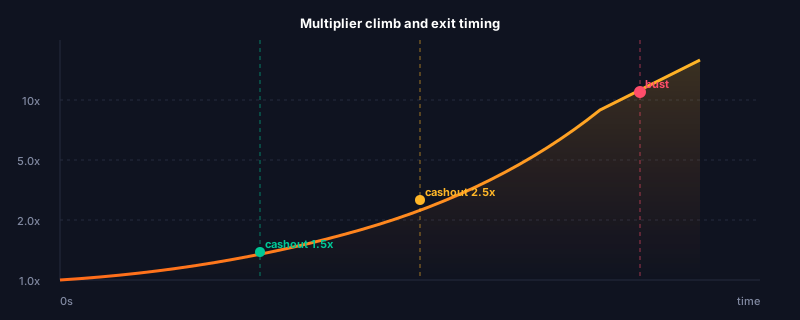
Almost every crash game lets you set an auto-cashout target. You decide in advance that any bet should exit at, say, x1.5 or x2.0, and the game does it for you. This removes the emotional component, which is where most players lose extra.
The math is straightforward. If you set autocashout at x2.0, your hit rate has to clear roughly 49 to 50 percent for break-even (depending on the exact RTP and game model). Setting it at x1.5 needs a hit rate around 66 to 67 percent. The further out you go, the lower your hit rate, but the larger each winning round.
For a session bankroll, the lower targets (x1.3 to x1.8) reduce variance but tighten your edge to zero. The higher targets (x3.0 and above) push variance up sharply but let a single hit recover several losses. Neither approach changes the long-term expected value.
Why Martingale fails here
Martingale is the system where you double your bet after every loss, then reset to base after a win. In a game with a 50 percent flat win probability and no maximum bet, it would work. Crash games have neither property.
The two failure modes:
- Casinos cap the maximum bet. After six or seven losses in a row, your next Martingale step exceeds the table limit and the system breaks. Six losses at 49 percent probability happens about 1.7 percent of the time. Over a few thousand rounds, you will hit it more than once.
- Even at a smaller scale, the recovery bet has to be large relative to your base. A $1 base, after five losses, becomes a $32 bet. The recovery wins back the previous five losses plus one base unit. The risk-reward is terrible. You are wagering $32 to net $1.
Anti-Martingale (double after wins) is mathematically the same losing proposition. Neither works.
Round history is not a signal
Every crash game shows a list of previous bust multipliers. Players will often look at a string of x1.x results and conclude that a high multiplier is "due." This is the classic gambler's fallacy. The seeding for each round is independent. Past results carry zero information about the next round.
The only thing the history tells you is whether the published RTP is being honoured over a large sample, which you can verify if the casino provides provably fair tools. If you see thousands of rounds without any high multipliers, that is worth questioning. A normal session of 100 rounds shows whatever it shows.
Practical session rules
Three things that actually help, distilled from the above:
- Set the session bankroll before you start, write it down if needed.
- Set autocashout at the start and do not change it mid-session. Decision fatigue makes for bad cashouts.
- Stop when you hit either the session loss limit or a clear win target (say, doubling the session bankroll). Walking away on a win is harder than walking away on a loss. Both are equally important.
What about hedging across two bets
Most crash games allow two simultaneous bets per round with independent autocashout targets. Some players run a low-target bet (say, x1.3) to recover stake, and a high-target bet (x10 or more) to chase a hit. The math here is identical: total expected value is still negative. It does redistribute variance, but it does not create edge. If the format appeals to you, fine. Just do not believe it gives you an advantage.
FAQ
What is the best autocashout multiplier?
There is no single best target. Lower targets (x1.3 to x1.8) reduce variance but produce small wins. Higher targets (x3 and above) produce occasional large wins but long losing streaks. The right choice depends on your bankroll size and tolerance for variance, not on any expected-value advantage.
Can I use a strategy from one crash game on another?
The mechanic is the same across titles, so bankroll and autocashout rules transfer. The exact bust distribution can vary slightly between providers (Spribe's Aviator and BGaming's Top Eagle, for example, use different curve models). Practical strategy does not change.
Is Top Eagle easier to win on than Aviator?
No. Both publish 97 percent RTP. The visible aesthetic differs (top-down vs side-on view), and Top Eagle has a higher maximum multiplier cap, but the expected value per dollar wagered is functionally identical.
Does setting a lower bet improve my odds?
It does not improve the per-round probability of winning. What it does is reduce the absolute size of your losses, which extends how many rounds you can play on a given bankroll.